Guide to British Shorthair Autoimmune Lymphoproliferative Syndrome (ALPS)
While generally hardy, with a median life expectancy between 9 to 15 years, with many living into their 20s with proper care, British Shorthair are susceptible to a specific and severe genetic condition known as Autoimmune Lymphoproliferative Syndrome (ALPS). This rare disorder presents a significant challenge for breeders and owners, making education and awareness paramount to protecting the health of these beloved cats.
Autoimmune Lymphoproliferative Syndrome (ALPS) is a non-neoplastic (non-cancerous) lymphoproliferative disease. In simple terms, it’s a disorder where the immune system’s lymphocytes a type of white blood cell crucial for fighting infection, multiply uncontrollably and fail to die off as they should. This leads to an accumulation of these cells in the body’s lymphoid tissues, causing significant health complications.
ALPS is a hereditary condition directly linked to a specific genetic mutation found within the British Shorthair breed. While other cats are not known to be affected by this particular variant, its presence in the British Shorthair gene pool means that responsible breeders must be aware of its existence and the methods available to prevent its transmission to future generations.
This guide provides an essential overview of ALPS in British Shorthair cats. We will delve into the biological mechanisms of the disease, its genetic inheritance, recognisable symptoms, diagnostic procedures, and management strategies. Most importantly, we will outline the critical role of genetic testing and responsible breeding in safeguarding the future of the breed.
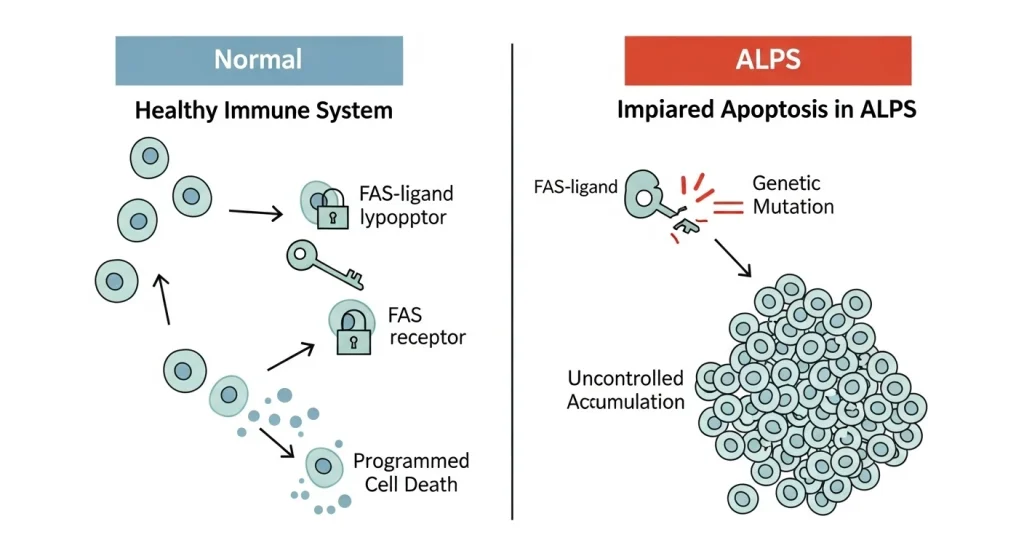
In a healthy cat, the FAS-ligand gene pathway signals excess lymphocytes to self-destruct. In a cat with ALPS, a genetic mutation breaks this signal, causing the cells to accumulate.
To grasp ALPS, it’s necessary to understand the fundamental immune process that it disrupts. The disease is not caused by an infection but by an internal failure of the body’s cellular regulation system.
A healthy immune system maintains a delicate balance. After an infection is cleared, the army of lymphocytes created to fight it is no longer needed. The body initiates a process called apoptosis, or programmed cell death, to safely eliminate these excess cells. In cats with ALPS, this crucial self-destruct mechanism is broken. Lymphocytes that should be removed persist and accumulate, leading to chronic immune system over-stimulation and enlargement of lymphoid organs.
Apoptosis is triggered through complex cellular pathways. One of the most important is the FAS pathway, which relies on a protein called FAS-ligand (FASL). When FAS-ligand binds to its receptor on a lymphocyte, it signals the cell to begin apoptosis. The genetic instructions for creating a functional FAS-ligand protein are contained within the FASLG gene. A mutation in this gene disrupts the production of a working FAS-ligand, effectively disabling the “off switch” for lymphocytes.
With the apoptosis pathway compromised, lymphocytes continue to proliferate unchecked. This defines ALPS as a lymphoproliferative disease. These excess cells infiltrate and overwhelm the lymph nodes and spleen, causing them to swell dramatically. This accumulation is the direct cause of the primary clinical signs associated with the condition.
ALPS is not a contagious disease; it is passed down through generations via a specific genetic flaw. Understanding its inheritance pattern is key to preventing it.
The specific mutation responsible for ALPS in British Shorthair cats is an insertion of a single DNA base (an adenine, “A”) in the FASLG gene, technically noted as c.418insA. This seemingly small change causes a “frameshift,” scrambling the genetic code from that point forward. The cellular machinery can no longer correctly read the instructions to build the FAS-ligand protein.
The frameshift mutation occurring in exon 3 of the gene quickly leads to a premature stop codon. This is like putting a period in the middle of a sentence. It signals the cell’s protein-building machinery to halt production long before the FAS-ligand protein is complete. The resulting protein is truncated and non-functional, rendering it incapable of initiating apoptosis.
ALPS is inherited in an Autosomal Recessive pattern. This means a kitten must inherit two copies of the defective gene one from each parent to be affected by the disease (homozygous).
Normal: A cat with two normal copies of the FASLG gene. It will not have ALPS and cannot pass the mutation to its offspring.
Carrier (Heterozygous): A cat with one normal copy and one mutated copy. A Carrier will not show any symptoms of ALPS but can pass the defective gene to 50% of its kittens.
Affected (Homozygous): A cat with two mutated copies. This cat will develop ALPS.
Responsible breeding is the only way to manage ALPS. Mating two Carrier cats is highly discouraged. According to Langford Vets, if two carrier cats are bred, there is a 25% chance of producing affected kittens, a 50% chance of producing more carriers, and only a 25% chance of producing normal kittens. Testing breeding cats for the mutation is therefore essential.
The clinical signs of ALPS are severe and appear very early in a kitten’s life, making prompt recognition critical.
Affected kittens appear normal at birth but develop severe symptoms soon after. The most prominent signs include:
Generalized Lymphadenopathy: Significant, widespread swelling of the lymph nodes throughout the body.
Splenomegaly: Marked enlargement of the spleen, often causing visible abdominal distension.
Lethargy and Poor Growth: Affected kittens fail to thrive, are often weak, and do not gain weight appropriately.
The chronic immune dysregulation can lead to secondary autoimmune problems. The most common is regenerative haemolytic anaemia, where the overactive immune system attacks and destroys the cat’s own red blood cells.
British Shorthair kittens with ALPS typically show signs around 6-8 weeks of age. The disease progresses quickly, and without intervention, the prognosis is extremely poor.
While the presentation is distinct, a veterinarian must rule out other causes of lymphadenopathy, such as infections or lymphoma (cancer). It’s also worth noting that British Shorthairs can be predisposed to other inherited conditions like Polycystic Kidney Disease (PKD), which, while having different symptoms, underscores the importance of comprehensive health screening in the breed. PKD is the most prominent inherited feline disease, affecting breeds including Persians and British Shorthairs, as highlighted by LABOKLIN (UK).
A definitive diagnosis of ALPS combines physical findings with specific laboratory and genetic testing.
A veterinarian’s suspicion of ALPS is usually raised by the combination of the kitten’s breed (British Shorthair), young age (6-8 weeks), and the presence of severe, generalised lymphadenopathy and splenomegaly on physical examination.
An abdominal ultrasound is a valuable tool to confirm the extent of splenomegaly and evaluate the size and structure of the internal lymph nodes, further supporting a presumptive diagnosis.
The only way to definitively confirm ALPS is through a genetic test. This test, typically performed on a blood sample or cheek swab, specifically looks for the c.418insA mutation in the FASLG gene. It can accurately identify if a cat is Normal, a Carrier, or Affected.
In some cases, a biopsy of a lymph node may be performed. Histopathology would show massive, non-cancerous proliferation of a specific type of lymphocyte, which is characteristic of ALPS and helps differentiate it from lymphoma.
Unfortunately, the outlook for kittens affected by ALPS is grave, and management focuses on palliative care rather than a cure.
There is no cure for ALPS. Treatment with immunosuppressive drugs like corticosteroids may provide temporary, partial relief of symptoms but does not alter the fatal course of the disease. The primary focus is on keeping the kitten comfortable.
Due to the rapid progression of the disease, frequent veterinary monitoring is required if palliative care is attempted. However, the kitten’s condition typically deteriorates quickly despite supportive measures. For the short time an affected kitten is alive, the goal is to minimise discomfort. This includes ensuring they are eating, managing pain, and providing a warm, stress-free environment.
The prognosis for kittens with ALPS is hopeless. Most affected kittens die or are humanely euthanized within weeks of diagnosis due to the severity of their symptoms and poor quality of life.
Autoimmune Lymphoproliferative Syndrome (ALPS) is a devastating genetic disease specific to the British Shorthair breed. Caused by an Autosomal Recessive mutation in the FASLG gene, it disrupts the vital process of apoptosis, leading to fatal, uncontrolled lymphocyte proliferation in young kittens. While there is no cure for affected individuals, there is a powerful tool for prevention: genetic testing.
For breeders, screening all breeding stock for the ALPS mutation is not just a recommendation it is a fundamental respnsibility. By identifying Normal and Carrier cats, breeders can make informed decisions to prevent Carrier-to-Carrier pairings, thereby ensuring no affected kittens are born.
For prospective owners, requesting ALPS test results from breeders provides peace of mind and supports ethical breeding practices that prioritize the long-term health and integrity of the British Shorthair breed. Through diligent testing and strategic breeding, the prevalence of this tragic disease can be effectively managed and ultimately eliminated from the gene pool.