
The Intricate Dance of Understanding Cat Mating
The domestic cat, a creature of both independent spirit and deep affection, engages in a reproductive ritual as fascinating as it is complex. Understanding the intricacies of feline mating is crucial for pet owners, aspiring breeders, and anyone invested in feline welfare. This guide delves into the biological symphony that orchestrates feline reproduction, from the subtle signals of a queen’s heat cycle to the successful birth of a litter. We will explore the hormonal influences, behavioural cues, and the physical mechanics involved, while also addressing the potential challenges and the vital role of veterinary care. By unravelling this “intricate dance,” we gain a deeper appreciation for the natural world of our feline companions and the responsibilities that come with it.
The journey of feline reproduction begins with the female cat, the queen, and her cyclical readiness to mate. This readiness is not a constant state but a precisely timed biological event governed by internal hormones and external environmental cues. Understanding the queen’s heat cycle is fundamental to comprehending feline mating, as it dictates when she is receptive to the advances of a tomcat and capable of conception. This cycle is a complex interplay of physiological changes, behaviour, and hormonal fluctuations that prepare her for potential pregnancy.
A cat’s reproductive life typically commences with the onset of sexual maturity, a milestone that varies between individuals and breeds but generally occurs between six to eight months of age. This developmental stage signifies that the queen’s ovaries are producing hormones that initiate her reproductive cycles. For male cats, known as toms, sexual maturity is also reached around this age, with their testes beginning to produce sperm and testosterone, making them capable of impregnating a receptive female. Early sexual maturity highlights the urgency for owners to consider spaying or neutering their pets to prevent unintended pregnancies and manage pet populations, especially considering the prolific reproductive capacity of cats.
Decoding the Estrous Cycle: Stages of Receptivity
The feline oestrous (heat) cycle consists of four distinct phases, each with unique hormonal profiles and behavioral signs that dictate a queen’s readiness to mate.
The feline estrous cycle, often referred to as the heat cycle, is the recurring period of sexual receptivity in female mammals. In cats, this cycle is characterised by distinct phases, each with unique hormonal and behavioural characteristics that dictate when a queen is receptive to mating. The cycle begins with proestrus, a preparatory phase where hormonal changes occur, and the queen may attract males but is not yet fully receptive.
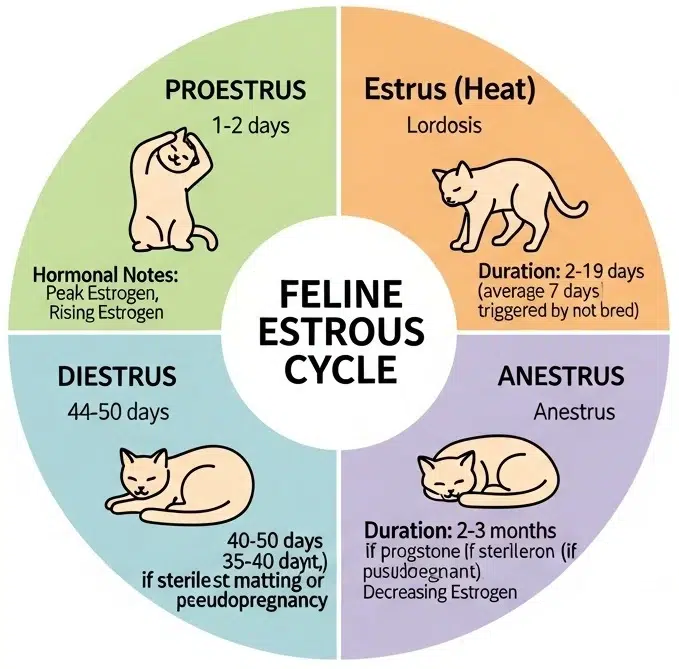
This is followed by estrus, the period of peak receptivity, where mating is most likely to occur and conception is possible. If mating does not occur during estrus, the queen may enter diestrus, a shorter luteal phase where progesterone is produced, or return to anestrus, a period of reproductive inactivity, especially outside the breeding season. The understanding of these estrous cycles is key to managing feline reproduction.
Identifying when a queen is in heat is crucial for managing her reproductive life. Behavioural changes are the most obvious indicators. A queen in heat often becomes unusually affectionate, rubbing against people and objects incessantly, and vocalising more frequently with yowls and moans that can sound distressed or insistent. She may also adopt a characteristic mating posture, known as lordosis, where she crouches low with her forequarters down and her hindquarters raised, often treading with her hind legs and shifting her tail to one side. Subtle physiological changes can also occur, such as an increase in tail flagging and a desire to be petted or picked up, but behavioural cues are usually the most apparent to the untrained eye. Unlike some other species, noticeable vulvar discharge is not a consistent or prominent sign in cats.
Cats are classified as seasonally polyestrous breeders, meaning they experience multiple estrous cycles within a specific breeding season. Their reproductive cycles are heavily influenced by photoperiod – the length of daylight. As days lengthen in spring and summer, cats tend to enter their breeding seasons. Conversely, during the shorter days of autumn and winter, many cats will enter anestrus and cease cycling. While indoor cats may experience less distinct seasonal changes due to artificial lighting, this natural rhythm remains a significant factor in feline reproduction. The typical breeding season often spans from early spring through late summer, though cats housed indoors with consistent lighting may cycle year-round.
The intricate hormonal orchestration of the estrous cycle is led by key hormones. Estradiol, a form of estrogen, plays a pivotal role during proestrus and estrus. It is responsible for the behavioural changes observed during heat, such as increased affection and vocalisation, and it also prepares the reproductive tract for potential fertilisation by increasing blood flow and causing changes in the uterine lining and the development of ovarian follicles. As the cycle progresses, if mating occurs, luteinizing hormone (LH) surges, leading to ovulation, and progesterone levels rise. Progesterone is essential for maintaining pregnancy. The dynamic interplay between estradiol and progesterone dictates the queen’s receptivity and her ability to carry a pregnancy to term.
While the queen’s cycle initiates the reproductive process, the male cat, or tom, plays an equally vital role. His readiness to mate, his ability to locate and court a receptive female, and his physical capacity for copulation are all integral to the success of feline reproduction. Understanding the tom’s preparedness, his specific mating behaviour, and his contribution to the reproductive process offers a complete picture of the mating dance.
Like queens, tomcats reach sexual maturity around six to eight months of age. At this point, their testes are fully developed and begin producing sperm and the hormone testosterone, which drives many of their mating-related behaviour. A mature tomcat is capable of reproducing, although his full reproductive capacity and confidence may continue to develop as he gains experience. Unlike queens, toms do not typically have distinct estrous cycles; they are generally able to mate at any time once sexually mature, provided there is a receptive female available. Their ability to locate receptive females is enhanced by their keen sense of smell, detecting pheromones from considerable distances.
A tomcat ready to mate exhibits distinct behavioural changes. Most notably, he may engage in territorial marking through spraying urine, which contains pheromones that signal his presence and reproductive status to other cats. He will also likely exhibit increased vocalisation, often with a deeper, more guttural sound, and may roam further from his usual territory in search of receptive females. A mature tomcat can detect the scent of a queen in heat from a considerable distance, a testament to his heightened sensory awareness during the breeding season. His territorial patrolling and vocalisations are all part of his mating behaviour to attract and secure a mate.
The tom’s reproductive organs are designed for efficient mating. It includes the testes, responsible for sperm production and testosterone synthesis; the epididymis, where sperm mature; the vas deferens, which transports sperm; and accessory glands (prostate and seminal vesicles) that produce seminal fluid to nourish and transport sperm. The penis is adapted for feline mating, featuring backward-facing barbs, which play a crucial role in inducing ovulation. This anatomical structure is specific to cats and distinguishes their mating process from many other mammals. The health of these reproductive organs is paramount for a tom’s reproductive capacity.
When a receptive queen encounters a mature tomcat, the intricate courtship and mating process unfolds. This is a complex behaviour interaction, unique to felines, that culminates in copulation and, critically, the trigger for ovulation. The success of this delicate dance is influenced by a multitude of factors, from individual cat personalities to the surrounding environment.
The courtship between a tom and a queen can be a prolonged and sometimes a bit aggressive affair. The tom will typically approach a queen in heat with caution, often vocalising and engaging in tentative advances. The queen, if receptive, will signal her willingness through body language, often rubbing against him and adopting the lordosis posture. The tom may circle her, sniff her, and engage in gentle nips. This ritual can involve vocalisations, chasing, and wrestling, which serves to solidify their bond and assess each other’s readiness and health. It’s a dynamic interplay of attraction and assessment, ensuring that mating between two cats occurs between viable partners. This is a crucial aspect of mating behaviour.
The act of copulation in cats is brief but intense. Once the queen is in the lordosis posture and the tom has successfully mounted her, he will grasp her by the scruff of the neck. This grip is believed to help immobilise her and may also trigger a reflex. The tom then inserts his penis, which is barbed, into the queen’s vagina. Copulation typically lasts only a few seconds to a minute. The tom will then dismount. This rapid sequence is characteristic of feline mating, a swift and efficient process focused on triggering ovulation and fertilisation.
A queen in heat may mate with multiple toms. Because ovulation is induced by mating, each mating event can stimulate the release of more eggs. If a queen mates with several different males during her estrus period, kittens in the same litter can have different fathers. This phenomenon, known as superfecundation, is a key feature of feline reproduction and contributes to the variability in litter size. It increases the genetic diversity within a litter and enhances the queen’s chances of conceiving. This also underscores the importance of managing intact female cats carefully, as a single mating does not guarantee pregnancy, and a queen may become pregnant by multiple sires over several days.
Following copulation, the queen may exhibit a characteristic reaction, often rolling on the ground or grooming herself intensely. She might also become aggressive towards the tom, sometimes hissing or swatting at him. This behaviour is thought to be a protective response or a way to dislodge sperm and prepare for further mating if necessary. The tom usually retreats and waits for another opportunity or moves on to seek other receptive females. The immediate aftermath is often characterised by a brief separation before the cycle of courtship and mating may resume, especially if ovulation has not yet been fully induced or if the queen remains in estrus.
While feline reproduction is a robust natural process, various factors can disrupt the intricate dance, leading to challenges in conception or a successful pregnancy. Understanding these potential hitches is essential for recognising problems and seeking appropriate veterinary guidance to maintain reproductive health.
The cornerstone of feline reproduction is induced ovulation. If mating is insufficient, ineffective, or if the queen has underlying hormonal issues, ovulation may not be triggered or may occur erratically. This failure to ovulate means that even if mating occurs, conception is impossible. Stress, poor health, or imbalances in reproductive hormones, such as those affecting the development of ovarian follicles, can all contribute to anovulation. Conditions like ovarian cysts can also interfere with normal hormonal signalling and ovulation.
Obstacles to mating between two cats can arise from both physical and behavioural issues in either the queen or the tom. Physical barriers can include abnormalities in the reproductive organs, pain associated with mating, or even a tomcat’s lack of experience or confidence. Behavioural issues, such as extreme aggression from either cat, fear, or lack of appropriate courtship, can also prevent successful copulation. In some cases, a tom may have phymosis, a condition where the foreskin of the penis does not retract properly, making penetration impossible. Addressing these barriers often requires veterinary intervention and careful management of the cats’ environment and interactions. These issues can lead to mating impossible.
Hormonal imbalances are a significant cause of reproductive irregularities in queens. Conditions such as cystic endometrial hyperplasia, endometrial hyperplasia, or persistent corpora lutes can disrupt the normal estrous cycle, leading to irregular heat periods, prolonged heat, or a failure to ovulate or cycle altogether. These hormonal imbalances and hormonal disorders can affect fertility and the ability to carry a pregnancy. Veterinary diagnostics are crucial for identifying and managing these complex issues.
Various infectious diseases can have a detrimental impact on feline reproduction and overall reproductive health. Conditions like feline herpesvirus-1 (FHV-1), while commonly associated with respiratory issues, can sometimes cause reproductive complications. More serious infections like Feline Leukemia Virus (FeLV) and Feline Immunodeficiency Virus (FIV) can compromise a cat’s immune system, making them susceptible to secondary infections that affect reproductive health. Other diseases, like Feline Infectious Peritonitis (FIP) and Toxoplasmosis, can also cause pregnancy loss. Maintaining a cat’s overall health through vaccination and regular veterinary check-up is paramount for reproductive health.
When reproductive challenges arise, a veterinarian is an invaluable resource. Diagnostic tools such as physical examination, blood tests for hormone levels (e.g., serum progesterone), and imaging techniques like ultrasound can help pinpoint the cause of infertility or pregnancy complications. Vaginal cytology can assess the stages of the estrous cycle, while laboratory data provides crucial insights. Veterinary consultation is essential for diagnosing hormonal imbalances, identifying physical abnormalities, assessing the impact of infections, and providing treatment plans. For breeders, regular veterinary check-up is crucial to ensure the reproductive health of their breeding stock and to manage potential risks associated with pregnancy and parturition.
Should the dance of mating culminate in conception, the queen embarks on the remarkable journey of feline pregnancy, culminating in the birth of a litter and the demanding, yet rewarding, post-partum period. This phase requires careful attention to both the mother and her developing offspring.
Confirming feline pregnancy typically occurs within a few weeks after mating. Early signs can be subtle and include a slight pinkish discolouration of the nipples (a condition known as “tomming”), a potential decrease in appetite followed by an increase, and a gradual weight gain. Abdominal palpation by an experienced individual or veterinarian can sometimes detect developing fetuses as early as the four week. More definitive confirmation comes through diagnostic imaging. A veterinary check-up may involve palpation, and an ultrasound can visualise the developing fetuses, confirm viability, and estimate litter size and due date. Monitoring fetal heart rates is also possible via ultrasound.
A cat’s gestation period lasts approximately 63-69 days, or around maximum 9 weeks. During this time, the fertilised eggs develop into fully formed kittens. The fetuses grow rapidly within the uterine horns, developing internal organs, skeletal structures, and sensory systems, all supported by the umbilical cord and fetal membranes. The queen’s body undergoes significant changes to support this development, including an increase in abdominal size and a need for increased nutritional intake to support the growing litter size. Queens under 3 years have the highest C-section rate (~15%), while older queens over 5 years have lower rates (under 6.5%).
As the due date approaches, the queen will typically exhibit nesting behaviour. She will instinctively seek out a quiet, safe, and secluded place to give birth, often choosing dark, enclosed spaces like closets, under beds, or in specially provided nesting box or nest box. Pre-labor signs may include restlessness, panting, vocalisation, and loss of appetite. She might also start licking her genital area more frequently. Observing these signs indicates that labour is imminent and provides an opportunity for owners to ensure a safe and comfortable birthing environment.
Parturition, or queening, is the process of giving birth. It typically occurs in stages. The first stage involves uterine contractions and cervical dilation, during which the queen may appear restless and uncomfortable. The second stage is the expulsion of the kittens. Kittens are usually born within an amniotic sac, which the queen will instinctively tear open and then proceed to clean the kitten and sever the umbilical cord. If she’s not doing all this the owner need to help the queen and do it for her. Each kitten is typically followed by a placenta; monitoring for retained placentas is important. The entire process can take several hours, and the queen will need a calm environment to focus on giving birth. In cases of prolonged labour or distress, feline dystonia may occur, potentially requiring a caesarean section.
Following parturition, the queen enters the post-partum period, where her primary focus is the care and nurturing of her newborn kittens. She will nurse them, keep them clean and warm, and stimulate them to eliminate. It is crucial to ensure the queen has access to fresh water and a high-quality, nutrient-rich diet to support milk production from her mammary glands. Close monitoring of both the queen and her litter is essential during this time. Any signs of lethargy, loss of appetite, or abnormal vulvar discharge from the queen, or if kittens appear weak, cold, or are not nursing well, warrant immediate veterinary check-up.
Newborn kittens, or neonates, are entirely dependent on their mother. Their survival hinges on the queen’s ability to provide adequate milk, warmth, and stimulation. Key aspects of kitten care include ensuring they are kept warm, as they cannot regulate their own body temperature. If the queen is unable to provide sufficient milk, supplemental hand-feeding with a kitten milk re-placer may be necessary. Keeping the kittens clean and observing their development such as weight gain daily, opening of eyes, and mobility is also vital. If any kitten shows signs of distress, prompt veterinary check-up is necessary. Responsible ownership also extends to considering kitten insurance for unexpected health needs.
The journey of feline reproduction is a testament to nature’s intricate design, a captivating dance orchestrated by hormones, behaviour, and physiology. From the initial signals of a queen’s heat cycle to the successful delivery and care of a litter, each step is a finely tuned element in the grand tapestry of feline life. Understanding these processes—the estrous cycle, induced ovulation, courtship rituals, gestation period, and parturition—provides invaluable insight for cat owners and those involved in breeding.
Moreover, this comprehensive understanding underscores the profound responsibility that comes with caring for cats. The reproductive potential of cats is immense, and without responsible management, it can contribute to overpopulation. Implementing spaying and neutering is the most effective strategy for population control and also offers significant health benefits for individual cats, reducing the risk of certain cancers and behavioural issues.
For those considering breeding, a deep commitment to understanding reproductive health, genetics, and potential complications is paramount. This includes diligent veterinary check-ups, awareness of infectious diseases like Feline immunodeficiency virus, Feline leukaemia virus, and feline herpesvirus-1, and avoiding practices that can lead to inbreeding depression. When challenges arise, such as failure to ovulate, mating impossible, or concerns about feline pregnancy, veterinary expertise and a structured diagnostic plan are essential.
Ultimately, the intricate dance of cat mating is a natural phenomenon that, when understood and managed responsibly, contributes to the well-being of both individual cats and the broader feline population. Responsible ownership, informed decisions about spaying and neutering, and a commitment to feline health are the final, crucial notes in this complex and beautiful symphony of life.